Recruitment in 2026. What Every Employer, Recruiter and Candidate Should Know

“Technology can help us recruit faster. It cannot make us recruit fairly. That responsibility still belongs to us.”
(A note on scope: this article concerns itself with recruitment in the United Kingdom. It draws on current UK employment legislation, recent guidance from the Chartered Institute of Personnel and Development, material published by the Information Commissioner’s Office, and a quarter of a century spent working across executive search, recruitment process outsourcing and inhouse talent acquisition. It is offered as an informed guide rather than as legal advice. Readers recruiting or seeking work outside the UK may recognise many of the underlying principles, but the law itself varies a good deal between jurisdictions, so it remains worth checking what applies where you actually operate.)
Why Recruitment Is Changing Faster Than It Used To
Spend five minutes scrolling through job advertisements on LinkedIn and you will probably find at least one that makes you raise an eyebrow. A role demanding 20+ years of executive level experience for what reads as a midlevel position. A vacancy requiring a degree with no obvious bearing on the work itself. A “recent graduate” scheme with suspiciously specific requirements. A grand executive title attached to a salary that tells a rather different story. Or an advertisement that reads as though it was written by a machine in under thirty seconds and never once looked at by a human being afterwards, which, increasingly, it was.
None of this proves an employer has done anything wrong. Equally, none of it should be waved through without a second glance.
Recruitment has always moved in step with the businesses it serves. What makes the present moment unusual is that technology, legislation and candidate expectations are all shifting at once. Artificial intelligence is changing how organisations find, assess and speak to candidates, while UK employment law continues to place greater weight on fairness, transparency and accountability. For employers, recruiters and candidates alike, keeping pace with both has rarely mattered more.

Recruitment Should Never Stop Being About People
Over twenty-five years across agency recruitment, executive search, RPO and internal talent acquisition, spanning Europe, Asia Pacific and North America. I have watched the profession change almost beyond recognition. When I started, CVs arrived by fax. LinkedIn did not exist. Artificial intelligence belonged to science fiction rather than to recruitment software. Today it can draft a job description, search a talent pool, suggest interview questions, screen a CV and reply to a candidate before a recruiter has so much as reached for the telephone.
Technology has undoubtedly made recruitment quicker. Whether it has made it better depends entirely on how it is used. The underlying purpose has not changed at all: to find the person best equipped to solve a particular business problem, while giving every candidate a genuine opportunity to show what they could contribute. Everything else exists to serve that purpose, not to replace it.

Why Employment Law Matters More Than Ever
The most significant change facing UK employers this year is not, in fact, artificial intelligence. It is employment law. Much of the press attention has settled on AI taking jobs or reshaping how recruiters work day to day. Rather more consequential, in practical terms, is the proposed reduction in the qualifying period for protection against unfair dismissal from two years to six months under the Employment Rights Bill, together with wider reform of probationary periods and workplace rights.
Whatever form the final legislation takes, the direction is unambiguous. Employers will need to place far greater weight on getting the decision right before someone joins, rather than relying on the safety net of a long probationary tail afterwards. That is not unwelcome news. It is, in most respects, simply what good recruiters have believed all along: the best process is not the one that fills a vacancy fastest, but the one that makes the right appointment.
There is an old adage in this trade that hiring is expensive. Hiring the wrong person is considerably more so. The bill runs well beyond salary, lost productivity, management time absorbed in managing the problem rather than the business, dented morale, wasted training, strained client relationships and, on occasion, legal proceedings. Six months later the organisation often finds itself recruiting for the very same role a second time, which few would describe as a triumph. Speed and efficiency, it turns out, are not the same thing at all.
Recruitment Is a Decision Made by Two Parties
These legislative changes do not concern employers alone; they concern candidates too. One of the more persistent mistakes professionals make is treating recruitment as a one-way assessment, conducted entirely by the employer, upon the candidate. It has never really worked that way. Employers interview candidates, certainly, but candidates ought to be interviewing employers with equal rigour: why has the role become available, is it newly created or a replacement, how will success actually be measured, what support exists during probation, and does the process itself resemble the culture the organisation claims to have?
A slightly higher salary is easy to find appealing. Joining the wrong organisation rarely is. I have watched senior professionals move for an increase in pay only to discover that the culture, leadership style or expectations bore little resemblance to what they had been led to believe. I have also watched candidates accept somewhat less because they believed in the leadership and the opportunity in front of them and, more often than not, those are the decisions that look wiser with the benefit of hindsight. Recruitment reduced to the matching of keywords against job titles misses the point entirely. It is, at its best, a search for fit on both sides of the table.

A More Professional Discipline
Recruitment is maturing into a genuinely professional discipline, which ought to be welcomed rather than resisted. The legal framework is becoming clearer, the available technology more capable, and candidates considerably better informed. Employers, for their part, are increasingly treating recruitment as a commercial function that shapes growth and culture, rather than as an administrative chore to be dispatched quickly.
The trouble is that governance rarely keeps pace with growth. Few organisations set out deliberately to build an unfair process. More commonly, the problem creeps in as the business expands: fifty employees become two thousand, one recruiter becomes twenty, hiring goes international, an applicant tracking system arrives, artificial intelligence is bolted on, external agencies are appointed, and hiring managers are handed greater autonomy. Before long, what was once the responsibility of a single careful person has become a sprawling, distributed operation. Growth is exciting. It is also the point at which consistency becomes genuinely difficult to maintain.
Good governance does not depend on one experienced recruiter simply remembering how things ought to be done. It rests on clear standards, proper training, shared knowledge and regular review, and it should produce the same quality of outcome regardless of who happens to be recruiting on a given Tuesday. That holds equally whether the organisation in question is a global bank, a fast-growing technology firm, or a family business hiring its next employee.
Start With the Problem, Not the Person Specification
One of the more useful questions I put to clients is simple: what problem are you actually trying to solve? It is remarkable how often that single question reshapes the entire brief. Many job descriptions open with a list of qualifications, years of experience or previous titles, none of which is usually the real reason someone is being hired. Organisations recruit to solve problems, an international expansion, an underperforming division in need of a firm hand, a change in regulation, stalled revenue, or simply a predecessor who did not work out. Understanding the problem tends to produce a sharper brief, and a sharper brief tends to produce a better hire. Employers would do well to spend as much time defining the role as they do searching for someone to fill it.
Are we measuring capability in a given area or time served?
One of the more common examples raised in the CIPD’s guidance concerns years of experience. Employers routinely specify something along the lines of “a minimum of 20 years’ executive level experience required.” At first glance this looks entirely sensible, experience does, after all, matter. UK employment law nonetheless requires employers to consider whether such requirements can be objectively justified, since they may indirectly disadvantage certain groups, younger applicants in particular. Rather than counting years served, the CIPD encourages employers to identify the actual competencies the role demands. The distinction sounds subtle. It can carry real legal weight, and it happens to make good commercial sense too: if the aim is to find the best available candidate, why narrow the field for no better reason than habit?
I often ask clients what 20 years’ executive level experience is meant to represent in practice. If the honest answer is someone who has led a regulatory transformation, run a global finance function, built a technology platform or turned around a struggling business, then those are the competencies the advertisement should describe, not the number of birthdays the candidate has accumulated along the way.
Some of the better appointments I have been involved in were people moving between industries entirely, chosen for leadership and judgement rather than a matching CV. Replacing like for like is the easiest decision to make. It is not invariably the best one.
Capability, in short, should be measured by outcomes rather than time served. The question worth asking is not how many years someone has done a job, but what they have actually achieved in it. Recruiting on that basis tends to widen the talent pool without preventing an employer from appointing highly experienced people where the role genuinely requires them.
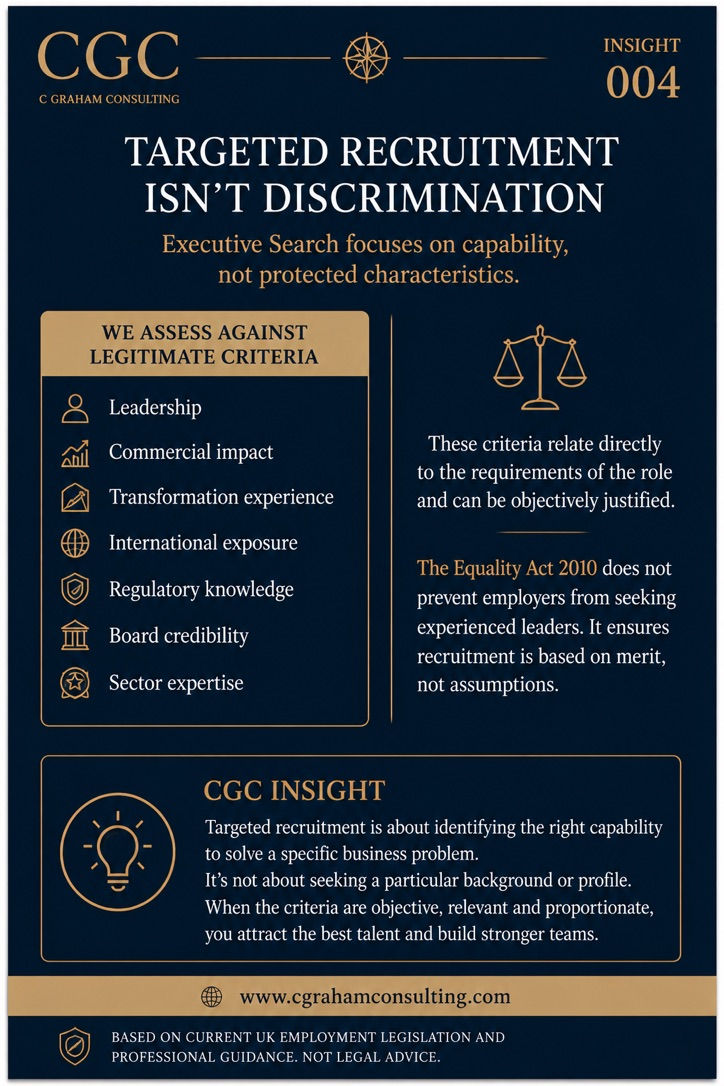
Executive Search Is targeted recruitment
A frequent source of confusion is targeted recruitment. Some assume that because executive search focuses on a comparatively small pool of people, it must sit uneasily alongside equality legislation. It does not. Executive search is a fundamentally different exercise from volume recruitment: I do not advertise executive assignments, and my task is to identify individuals capable of solving a specific business challenge. That judgement rests on evidence, leadership record, commercial performance, transformation experience, sector knowledge, international exposure, board credibility, regulatory understanding, stakeholder management and the ability to deliver a measurable result, rather than on age, gender or any other protected characteristic.
There is an important difference between targeted recruitment and discriminatory recruitment. Approaching someone because they delivered a complex banking transformation is a very different act from excluding someone because of a characteristic protected under the Equality Act. The law does not stop employers from seeking experienced leaders; it simply expects the criteria used to be relevant, proportionate and capable of being justified if challenged.
Where Artificial Intelligence Actually Fits
Artificial intelligence is already reshaping recruitment, and there is little cause for either surprise or alarm in that fact on its own. Recruiters have used technology for years, applicant tracking systems, LinkedIn Recruiter, Boolean search, psychometric testing, video interviewing and AI is best understood as the next chapter in that story rather than an entirely new one. What has changed is the sheer reach of it: AI can now draft advertisements, search CV databases, identify candidates, screen applications, suggest interview questions, summarise interviews and correspond with candidates, often touching far more of the process than any previous tool.
Used well, this can meaningfully improve productivity. Used carelessly, it can also reproduce poor recruitment practice at considerable speed and scale, which is precisely why the legal framework matters so much. The CIPD is clear that AI assisted recruitment remains subject to existing UK employment legislation, including equality law, data protection and the Data (Use and Access) Act 2025. Employers remain responsible for ensuring that automated processes are fair, transparent and properly monitored; artificial intelligence does not, and cannot, take legal responsibility off an employer’s hands.
The more important message here is not really about AI at all. It is about accountability. Someone still writes the prompt, approves the advertisement, configures the system, decides which competencies count as essential, and decides who is invited to interview. Technology can inform those decisions. It cannot own them artificial intelligence ought to support professional judgement, not substitute for it. It can help an organisation recruit more efficiently; only people can keep that recruitment fair, proportionate and lawful.
The Governance Challenge
The greater risk, in my experience, is not artificial intelligence itself but the assumption that because a process has been automated, it must also be compliant. The two are not the same thing at all. Technology simply scales whatever process already exists, where governance is sound, AI becomes a genuinely valuable tool; where governance is weak, it merely allows old mistakes to be repeated faster and on a much larger scale. Good governance is not about slowing recruitment down for its own sake. It is about making sure growth never outpaces judgement.
Common Mistakes, and the Question That Usually Prevents Them
Most recruitment mistakes do not arise because an organisation set out to exclude anyone. They arise because nobody paused to ask a very simple question: why? Why insist on this qualification, why 20 years rather than 15 or 25, why does a degree matter here, why advertise only in this one place, why reject these particular candidates, why does the interview process take the shape it does? Where there is a clear, objectively justifiable commercial reason, the process is usually heading in the right direction. Where nobody can quite answer the question, that is generally where the conversation ought to begin.
Words Matter
A job advertisement is not merely a marketing document; it is often the very first impression an organisation makes on someone. The CIPD points to several examples of wording that can unintentionally disadvantage certain applicants or add legal risk phrases such as “recent graduate” or “young and enthusiastic,” unnecessary qualification requirements, or a fixed number of years’ experience, all of which may need objective justification depending on the circumstances. The guidance encourages employers to describe the competencies the role genuinely requires rather than an unspoken assumption about the sort of person who might hold it.
None of this means every vacancy must appeal to everyone. A graduate scheme will naturally draw graduates; an executive search assignment will naturally target experienced leaders, and neither approach is remotely wrong. The question that matters is simply whether the criteria can be explained. Good recruitment, in this sense, starts less with the question of who we want and more with what problem we are trying to solve the answer to which tends to produce a sharper description, a better search and, ultimately, a better appointment.
Candidates have responsibilities too
This article has largely addressed employers, but candidates carry their share of the responsibility as well. The recurring mistake here is rarely poor recruitment; it is poor career decision making, applying for fifty roles without reading any of them properly, accepting an offer purely because the number is larger, ignoring plain warning signs at interview, or simply never asking why the role exists or what success will look like. Recruitment ought never to be a one-way conversation, and candidates should interview employers with just as much rigour as employers apply in reverse. As probationary periods shorten under the proposed reforms, that scrutiny matters more, not less: joining the wrong organisation can prove every bit as costly as hiring the wrong employee, for both sides of the arrangement.
Recruitment Is Not Finished When the Contract Is Signed
One of the more persistent misconceptions is that success is achieved the moment someone signs an employment contract. It never really has been. The true measure comes later at six months, twelve months, three years in whether the person has added value, whether they have stayed, whether the team around them has grown stronger, and whether the original business problem has actually been solved. Everything before that point is simply process.
As organisations continue adopting artificial intelligence, updating their recruitment technology and adjusting to a changing legal landscape, conversation will inevitably turn to automation, efficiency and productivity. Those conversations matter. They should not, however, become the only ones taking place. The strongest organisations I have worked with have never treated recruitment as administrative housekeeping. They have treated it as one of the more consequential commercial decisions a business makes, because every appointment changes that business sometimes for the better, occasionally for the worse. Good recruitment does not eliminate that risk. It reduces it. Technology will not replace judgement, employment law will not replace common sense, and artificial intelligence, for all its evident usefulness, will not replace a genuine working relationship. What all three can do is support organisations that actually want to recruit fairly, transparently and well.

How should we measure recruitment success?
One of the recruitment industry's favourite metrics is time to hire. It is easy to measure, easy to benchmark and often presented as evidence of an efficient recruitment function. Used in isolation, however, it tells us remarkably little about whether the right hiring decision was made.
A vacancy filled in fourteen days may look impressive on a dashboard, but if that individual leaves within six months, underperforms in the role, or the organisation finds itself restarting the search, the original speed becomes largely irrelevant. Recruitment has not been successful simply because it was completed quickly.
The organisations that consistently make strong hiring decisions tend to measure something altogether different. They look at quality of hire, retention, performance, succession, internal promotion, and whether the individual has genuinely solved the business problem they were recruited to address. Those are outcomes that can only be judged months, and often years, after an appointment has been made.
There is, of course, a balance to be struck. Few businesses can afford recruitment processes that drift on indefinitely. Equally, rushing a search simply to improve a performance metric rarely serves anyone well. A disciplined executive search or recruitment process may take longer at the outset, but it often saves considerable time, money and disruption by reducing the likelihood of a costly mis-hire.
In recruitment, as in most commercial decisions, quality is ultimately remembered long after speed has been forgotten.
Whether you are leading an organisation, hiring your next executive, advising clients or considering your own next career move, the principles remain remarkably consistent: ask better questions, challenge assumptions and understand the legal, commercial and technological environment in which recruitment now operates.
Technology will continue to evolve. Artificial intelligence will become more capable. Employment legislation will continue to change. None of those developments, however, remove the need for sound judgement. They simply increase its importance.
The strongest organisations will not be those that recruit the fastest or adopt every new technology first. They will be the ones that combine innovation with good governance, use AI to support rather than replace human judgement, and remain focused on identifying the people who can genuinely solve business problems and create long-term value.
For candidates, the lesson is equally important. Recruitment is not something that happens to you; it is a decision you make alongside your future employer. The right opportunity is rarely defined by salary alone, but by leadership, culture, purpose, influence and the opportunity to make a meaningful impact.
Ultimately, recruitment has never really been about filling vacancies. It is about making informed decisions that shape organisations, careers and, in many cases, the future direction of a business. Every appointment carries risk, but a thoughtful, well-governed recruitment process significantly reduces that risk.
A job advertisement may start the conversation, but it is never the measure of success. The true measure of recruitment is seen months and years later, in the quality of the hire, the value they create, and the lasting impact they leave behind.


.png)
Comments