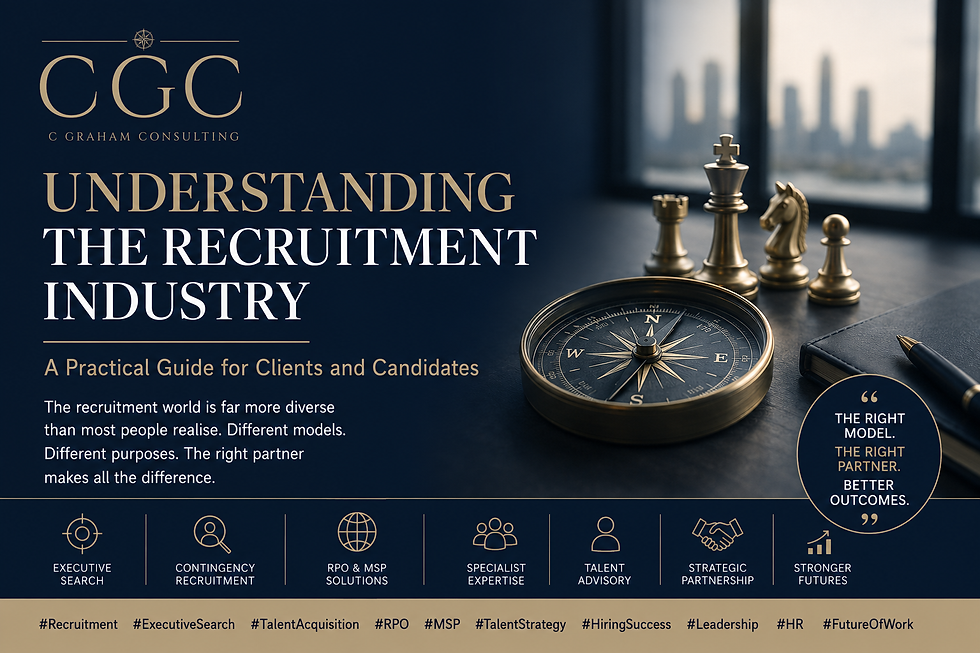
Understanding the Recruitment Industry: A Practical Guide for Clients and Candidates

During more than twenty-five years working in Contingency recruitment, retained Executive search, Recruitment Process Outsourcing and in-house Talent Acquisition, there is one question I have probably been asked more than any other. "What is the difference between your company and all the other recruitment firms?" It is a perfectly fair question, and one I still rather enjoy answering, mainly because the honest answer takes longer than most people expect.
From the outside, recruitment looks deceptively simple. A company needs to hire someone, contacts a recruiter, receives a shortlist, appoints a candidate and pays a fee. Job done, everybody shakes hands, the end. The reality is considerably less tidy.
One of the biggest misconceptions in this industry is that the word "recruiter" describes a single profession, in the way that "dentist" or "plumber" does. It does not. Recruitment today is an umbrella term covering a remarkably broad range of businesses with entirely different commercial models, objectives and areas of expertise. Some specialise in temporary staffing, others recruit contractors, some effectively become an organisation's outsourced hiring department, and others might spend six months quietly advising a board on the appointment of a new chief executive. They all sit under the same broad heading, but beyond that the similarities can be surprisingly thin.
Understanding those differences matters to candidates, because it helps explain why their experiences with recruiters can vary so wildly from one encounter to the next. It matters even more to employers, because choosing the right recruitment partner for the problem at hand makes the difference between a smooth hire and a frustrating one. Comparing every recruitment firm purely on the size of its fee is a little like comparing every solicitor or accountant on hourly rate alone, without first asking what service you are actually buying. They may share a profession, but they are not interchangeable.
Like most industries, there are exceptions to every rule, but broadly speaking, recruitment today falls into several distinct business models, each built to solve a different sort of hiring problem.
Contingency recruitment is the model most people recognise, largely because it is the one most people have encountered. A company has a vacancy and sends it to several agencies at once. Those agencies compete to put candidates forward, and only the one whose candidate is eventually hired gets paid. Well-known names such as Michael Page, Robert Walters, Hays, Robert Half and Morgan McKinley, along with thousands of independent firms, operate predominantly on this basis. Fees typically run from around fifteen to thirty per cent of a candidate's first year base salary, though they can stray outside that range depending on the role, location and how exclusive the assignment is. For roles such as a finance manager, an HR business partner or a sales manager, where speed matters and the market is reasonably liquid, this model can work very well, not least because the client generally pays nothing unless somebody is actually hired.
That commercial risk, however, sits almost entirely with the recruiter. An agency might spend days or weeks sourcing candidates and managing interviews, only to discover a rival firm filled the role first, or that the client recruited directly. Unsurprisingly, this encourages recruiters to move quickly, run several assignments at once, and concentrate their energy where they believe the odds of success are best. There is nothing improper in that. It is simply how the model has evolved, rather in the way that fast food restaurants have evolved to favour speed over a leisurely three-course experience.
Retained executive search is often billed as the premium end of recruitment, which is a slightly misleading description, since it implies the only difference is price. It is not. Executive search exists because certain appointments demand a fundamentally different approach. When a board is searching for a chief executive, chief financial officer, managing director or chief risk officer, the strongest candidate is frequently not looking for a new role at all, and there may be only a small handful of people anywhere with the right blend of leadership experience, commercial judgement and cultural fit. Finding them requires detailed market mapping, confidential approaches and, above all, trust. Clients engaging a search firm are not simply paying someone to surface candidates; they are appointing an adviser who can provide market intelligence, benchmark remuneration, assess leadership capability and represent the organisation discreetly.
Unlike contingency recruitment, executive search is usually retained: rather than inviting several firms to compete, the client appoints one to run the assignment exclusively. Fees typically range from twenty-five to thirty-five per cent of total guaranteed annual compensation, generally paid in stages rather than only on success, with a common structure being roughly a third at the outset, a third on presentation of the shortlist and a third when the chosen candidate actually joins. Some clients initially baulk at this compared with contingency pricing, without quite realising they are buying a fundamentally different service. Globally recognised firms in this space include Spencer Stuart, Egon Zehnder, Russell Reynolds Associates, Heidrick & Struggles, Korn Ferry and Odgers Berndtson, alongside a great many excellent boutiques specialising in particular sectors or functions.
Another popular misconception is that the largest firms automatically provide the best service. Sometimes they do; sometimes they very much do not. Some of the best recruiters I have worked alongside have built their careers inside global organisations, while others run highly respected businesses employing fewer than ten people. The difference has rarely been the size of the company on the letterhead. It has almost always been the expertise of the individual sitting across the table.
This brings us to a closely related point: global does not always mean global. People often assume that because a recruitment company has offices in twenty or thirty countries, every consultant within it works internationally and has access to opportunities everywhere. The reality is usually far more local. Many international recruitment businesses operate as a collection of individual country or regional units, each with its own budget, targets and profit-and-loss responsibility. Offices may collaborate on paper, but consultants are typically measured on the revenue generated within their own patch, and sharing an assignment across borders often means sharing the fee, which tends to dampen enthusiasm rather quickly. So despite the global signage in the lobby, much of the day-to-day business remains stubbornly local.
The same logic applies within a single country. One consultant may recruit nothing but audit professionals for the Big Four across West London. Another may specialise exclusively in private banking appointments in Zurich. A third might spend an entire career placing cyber security specialists in Singapore. That level of specialisation is often precisely why clients hire them in the first place, because it produces an instinctive feel for what a strong candidate in that narrow field actually looks like. The downside is that this same instinct can make it harder to recognise talent that does not fit a familiar mould. The more narrowly someone has worked, the easier it becomes to measure every new candidate against the hundreds of similar people placed before them, which works neatly when careers follow a conventional path and rather less neatly when they do not.
I have come across plenty of strong leaders whose careers wandered through banking, consulting, technology and professional services across London, Singapore, Hong Kong, New York and Dubai. On paper, those careers sometimes look untidy, simply because they refuse to sit in one box. In practice, these are often the people who bring fresh thinking and adapt quickest to new environments, which is precisely the sort of candidate a good search consultant should be hunting for rather than overlooking. By the time someone reaches director, partner or chief executive level, another pay rise is rarely the whole story. The real conversation tends to be about influence, ownership, culture and legacy, and understanding those motivations properly takes time and credibility, which is one reason executive search, for all the recent enthusiasm about artificial intelligence, remains a stubbornly human, relationship-driven business.
Beyond agencies and search firms, the industry stretches considerably further. Recruitment Process Outsourcing providers, such as AMS, Allegis Global Solutions, Cielo, Hudson RPO and Korn Ferry RPO, effectively become part of a client's internal hiring function, supporting organisations that need to recruit hundreds or thousands of people each year. Rather than charging a placement fee, they are usually paid through a service agreement, often structured around monthly management fees, project fees or a cost-per-hire arrangement, since this model is built for scale rather than the occasional senior appointment.
Staffing and contract recruitment make up another significant slice of the market, supplying temporary workers, interim managers and specialist contractors for fixed periods, with sectors such as healthcare, logistics, manufacturing and engineering relying heavily upon it. Rather than charging a percentage of salary, these agencies usually earn a margin on the worker's hourly or daily rate, which can range anywhere from around ten to over forty per cent depending on the sector and skill level involved. Large organisations sometimes appoint a Managed Service Provider to oversee their entire network of temporary labour suppliers; the MSP itself often does little direct recruiting, instead managing supplier performance, compliance and reporting on the client's behalf.
One of the faster growing corners of the market has been Employer of Record services, including providers such as Deel, Remote, Velocity Global, Multiplier and Oyster. These organisations do not necessarily recruit anyone themselves. Instead, they legally employ workers on a client's behalf, allowing a technology company in the United States, say, to employ someone in Singapore, France or Brazil without first establishing a local legal entity. Pricing is usually a monthly fee per employee rather than a recruitment fee, and can range from a few hundred to well over a thousand pounds or dollars a month depending on the country and the services included.
Finally, there are firms that barely touch recruitment in the conventional sense at all, such as Mercer, Korn Ferry Consulting, Aon and Willis Towers Watson, along with the human capital practices within the major professional services firms. These advise on workforce planning, succession, organisational design and leadership development. Their value lies less in introducing candidates and more in helping organisations make better long-term decisions about their people.
Having managed recruitment budgets and agency panels myself, I understand exactly why procurement teams gravitate towards comparing percentages; it is a perfectly natural instinct. The trouble is, that a bare percentage rarely tells the whole story, because the underlying commercial models are so different. A contingency recruiter might charge twenty per cent because payment depends entirely on success. A search firm might charge thirty per cent because it is committing months of dedicated, advisory work regardless of outcome. An RPO contract can look expensive until the cost is divided across two thousand annual hires. A staffing business, meanwhile, earns its money on a margin rather than a placement fee altogether. Simply lining up percentages side by side tells you remarkably little; the more useful question is whether the commercial model actually matches the hiring problem you are trying to solve.
Candidates, for their part, often describe recruitment as either wonderful or dreadful, having usually experienced only a narrow slice of the industry. Someone registered with a temporary staffing agency might hear from a recruiter several times a week. A contractor might speak to one regularly because renewals are simply part of the relationship. An executive search consultant, by contrast, might make contact only once every few years, when a genuinely relevant opportunity arises. None of these approaches is inherently right or wrong; they simply reflect different business models and different expectations.
So, which type of recruitment partner does a given situation actually call for?
An organisation appointing a chief executive, chief financial officer or board director is almost certainly looking for a retained executive search firm. One needing a finance manager, HR business partner or sales manager fairly quickly is probably better served by a contingency agency. An organisation hiring hundreds of graduates or customer service advisers every year may find an RPO provider the more efficient answer. A business needing warehouse staff, healthcare professionals or engineering contractors should look towards staffing specialists built precisely for that purpose, while a company expanding abroad without setting up a legal entity will likely need an Employer of Record instead. None of these models is superior to the others; they simply solve different problems, much as nobody seriously argues a screwdriver is better than a hammer.
At C Graham Consulting, we operate primarily within the retained executive search and leadership advisory market, specialising in senior appointments across Financial Services, Technology and Management Consulting throughout APAC, EMEA and increasingly North America. My own career has taken me through contingency recruitment, executive search, global Talent Acquisition leadership and Recruitment Process Outsourcing, and I have also sat firmly on the client side, managing agency panels of more than thirty-five recruitment firms while running global hiring programmes. Having viewed the industry from almost every angle, I understand both what clients expect of recruiters and what recruiters are realistically trying to deliver, which is a useful vantage point when the two sides occasionally talk past one another.
That breadth of experience has shaped how I approach search today. Technical expertise still matters, of course, but I have learned that the best appointments are not always the most obvious ones. Leadership, judgement, curiosity and adaptability frequently outweigh a flawless CV, and some of the strongest placements I have made, have involved persuading a client to value transferable skill over a candidate who merely looks identical to the person who just left. Equally, I do not believe every assignment should end in a placement. Sometimes the right answer is to promote internally. Sometimes it is to redesign the role. Sometimes, rather unglamorously, it is simply to wait for the right moment.
None of those conversations generates a fee, but they do build trust, and trust is ultimately what this entire industry is built upon, however many algorithms get added to the process along the way.
I remain convinced there is no single perfect way to recruit. I have used retained search, contingency recruitment, RPO, internal Talent Acquisition and direct sourcing, and every one of those models has worked exceptionally well when applied to the right problem, and rather badly when it was not. Recruitment, when you strip away the fee structures and the acronyms, has never really been about filling vacancies. It has always been about helping organisations make better decisions about people, and those decisions, more often than they might admit, turn out to be among the most important ones they ever make.


.png)
Comments