Why Modern Leadership Is Becoming a Test of Character
- chris251714
- May 18
- 7 min read
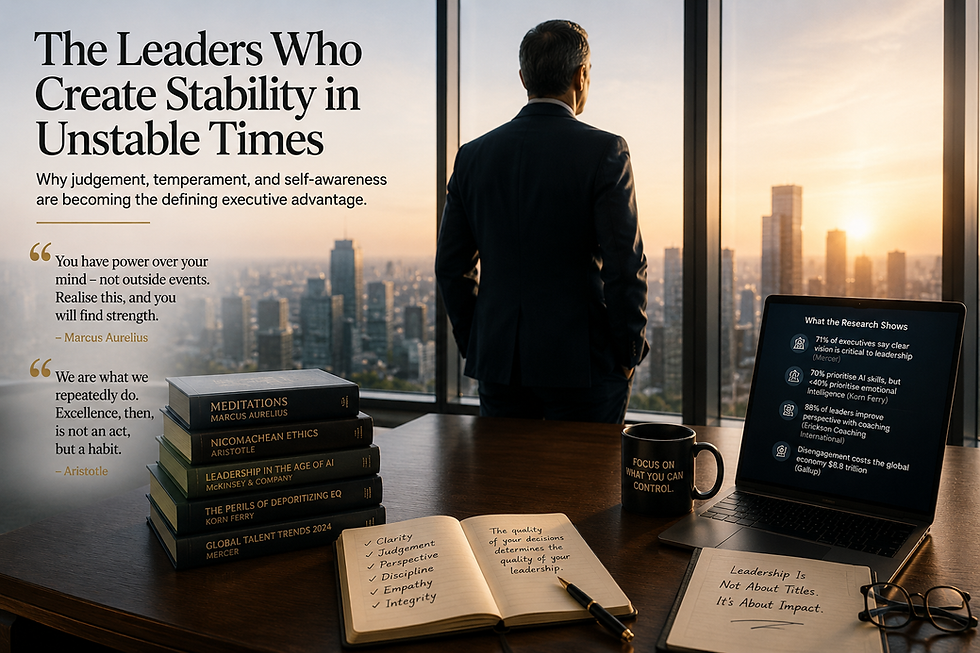
There is a moment in most executive careers when people realise that leadership is not primarily a test of intelligence.
Nor is it entirely a test of technical expertise, strategic frameworks, operational scale, or how confidently somebody can say the words “digital transformation” while pointing at a slide containing several upward arrows.
Eventually, leadership becomes something far more uncomfortable.
It becomes a test of temperament.
The higher individuals progress within organisations, the less protection exists between them and uncertainty, politics, pressure, conflict, ego, and responsibility. By the time someone reaches C-suite or Partner level, the role is no longer simply about delivering results. It becomes about whether they can continue making sound decisions while surrounded by incomplete information, competing interests, difficult personalities, organisational fatigue, investor scrutiny, and the occasional colleague who treats every minor operational setback as if civilisation itself is hanging by a thread.
Marcus Aurelius understood this remarkably well nearly two thousand years ago when he wrote:
“The people I deal with today will be meddling, ungrateful, arrogant, dishonest, jealous, and surly.”
Most modern executives could arrive at the same conclusion somewhere between the third meeting of the morning and an unread email marked “urgent” sent at 23:47 the previous evening.
What made Aurelius different was not that he recognised difficult people exist. Every leader eventually learns that. What mattered was his refusal to allow other people’s behaviour to determine his own standards, judgement, or emotional discipline.
That principle may now be more commercially relevant than ever.
Because despite extraordinary advances in technology, analytics, AI capability, and organisational design, many modern leadership failures remain deeply human in nature.
Not lack of intelligence.
Not lack of technical expertise.
But ego. Fragility. Short-term panic. Poor judgement under pressure. Inability to listen. Emotional volatility disguised as passion. Leaders who slowly exhaust organisations psychologically.
Increasingly, boards are beginning to recognise the difference.
For years, executive hiring focused heavily on measurable achievements. Career progression, institutional pedigree, transformation programmes, revenue responsibility, and strategic accomplishments often dominated assessment processes. Naturally, these things still matter enormously. Organisations still require technically capable executives, a calm CFO incapable of understanding liquidity risk remains a problem regardless of how emotionally evolved they may be.
However, the operating environment itself has changed.
Boards and leadership teams are now functioning inside conditions of near-permanent uncertainty. AI disruption, geopolitical fragmentation, cybersecurity threats, restructuring programmes, regulatory pressure, activist investors, workforce fatigue, and declining institutional trust are no longer occasional challenges. They have become structural features of modern business life.
As a result, organisations are beginning to reassess what leadership capability actually means over the long term.
One of the more interesting shifts occurring in executive search is that many boards are no longer asking only whether an individual can lead during success. They are asking what happens when conditions deteriorate.
How does the executive behave when certainty disappears? What happens when a transformation programme begins failing publicly? How do they react when challenged by the board? Can they absorb criticism without becoming defensive? Do they maintain perspective under pressure? Or do they create instability around themselves?
These questions matter because pressure amplifies behaviour already present beneath the surface.
Some leaders become clearer during adversity. Others become theatrical.
Some executives create alignment. Others spread anxiety through the organisation with the efficiency of a highly contagious respiratory illness.
The distinction becomes visible remarkably quickly.
Research increasingly supports this reality. DDI’s Global Leadership Forecast found that 71% of leaders report significantly increased stress levels, while more than half express concern about burnout. At the same time, organisations continue operating under expectations of constant transformation, continuous adaptation, and immediate execution.
Under those conditions, leadership behaviour stops being theoretical.
It becomes operational.
This is partly why recent research from Korn Ferry is so revealing. While organisations increasingly prioritise AI capability and technical sophistication, fewer than forty percent place equivalent emphasis on emotional intelligence within leadership selection.
Korn Ferry’s conclusion was refreshingly blunt:
“If you hire a CEO with low emotional intelligence, that’s going to backfire.”
Not eventually.Immediately.
Modern organisations are simply too interconnected for unstable leadership behaviour to remain isolated. A reactive executive influences communication quality, decision-making speed, team cohesion, retention, morale, governance, and ultimately financial performance.
This is where the discussion becomes particularly interesting, because many of the qualities now being described through the language of behavioural psychology and leadership science were identified centuries ago through philosophy.
Aristotle, for example, was less interested in abstract intellectualism and more interested in practical wisdom how capable people make good decisions consistently over time. His work in Nicomachean Ethics focused heavily on character, discipline, judgement, and what he described as eudaimonia, often translated as human flourishing.
That idea remains highly relevant in executive careers today.
Many senior leaders eventually discover that status, compensation, title progression, and organisational prestige do not automatically create fulfilment or sustainable performance. Increasingly, executives are asking more difficult questions:Does this organisation align with my values? Can meaningful work actually be done here? Will this role improve my life or slowly consume it? Do I respect the people I work with? Is the leadership team serious, or merely political?
These are not soft questions.
They are strategic ones.
One of Aristotle’s most enduring observations was:
“We are what we repeatedly do. Excellence, then, is not an act, but a habit.”
That may be one of the most accurate descriptions of executive leadership ever written.
Because over time, people reveal themselves through patterns:how they behave under stress,whether they take responsibility,how they treat colleagues during adversity,whether success improves their judgement or inflates their ego,and whether they remain constructive when conditions become difficult.
A résumé rarely captures this properly.
Experience alone is not character.
This is precisely why executive assessment is becoming progressively more psychological. The strongest executive search processes increasingly examine not only capability, but behavioural consistency over time.
Interestingly, the modern coaching industry is also arriving at remarkably similar conclusions. Erickson Coaching International places heavy emphasis on self-awareness, accountability, resilience, emotional regulation, and leadership perspective. Its coaching studies found substantial improvements in leadership effectiveness, planning capability, and strategic perspective among leaders who developed stronger awareness of their own behavioural patterns.
The reason this matters’ is simple.
A surprising number of executive failures stem not from incompetence, but from lack of self-awareness.
Some leaders believe they are creating urgency when they are mainly spreading anxiety. Others think they are being decisive when they are simply intimidating. Authority has a remarkable ability to magnify blind spots.
The strongest leaders usually possess something rarer than confidence.
Perspective.
They can listen without insecurity.They can alter course without experiencing it as humiliation.They can tolerate disagreement without becoming hostile.They do not require emotional victory in every discussion.
Aristotle captured this beautifully:
“The educated mind is able to entertain a thought without accepting it.”
That may be one of the finest descriptions of executive judgement ever written.
Because many organisations today do not suffer from lack of intelligence.
They suffer from excess certainty combined with insufficient humility.
This becomes particularly relevant in modern corporate environments where speed is often mistaken for wisdom. Entire organisations now operate inside cycles of permanent urgency. Every initiative becomes “transformational.” Every deadline becomes “critical.” Every operational adjustment arrives accompanied by a presentation suggesting the future survival of the enterprise depends entirely upon completing a spreadsheet before Thursday afternoon.
The difficulty with permanent urgency is that people eventually stop thinking clearly.
Exhaustion narrows perspective. Politics intensify. Decision-making deteriorates. Organisations slowly lose the ability to distinguish genuine crises from manufactured drama.
Ironically, many highly effective leaders operate very differently.
They are often calmer than expected. More measured in conversation. Less interested in performance theatre. Less emotionally erratic. More selective with words.
Not passive. Not weak. Simply, difficult to destabilise.
Research from McKinsey & Company increasingly supports the importance of these qualities. McKinsey notes that while AI can optimise systems, process data, and improve operational efficiency, it cannot replace mature judgement, trust-building, moral reasoning, or the ability to guide organisations through ambiguity and uncertainty.
Ironically, the more technologically advanced organisations become, the more valuable deeply human leadership qualities appear to become.
This is also why trust is becoming economically important rather than merely cultural. Research from Mercer found that seventy-one percent of executives believe communicating a clear vision is essential during periods of disruption and transformation.
Again, this sounds obvious.
Yet many organisations today suffer not from lack of intelligence, but from lack of clarity.
Employees can generally tolerate difficult realities.They can tolerate demanding markets.They can tolerate change.
What they struggle to tolerate is confused leadership.
Similarly, research from CIPD continues to show strong links between healthy organisational cultures, engagement, productivity, retention, and wellbeing.
This is not sentimentality.
It is operational reality.
People perform better when they trust leadership.They collaborate more effectively.Recover faster from setbacks.Make better decisions.Remain longer within organisations.
Conversely, environments dominated by fear, inconsistency, ego, or political behaviour eventually create paralysis. Organisations rarely describe this directly. Instead, they discuss symptoms:poor collaboration,retention issues,disengagement,decision bottlenecks,or “cultural challenges.”
The underlying issue is often behavioural leadership patterns repeated consistently over time.
One of the more encouraging aspects of all this, however, is that leadership temperament is not fixed.
People can develop perspective. They can improve self-awareness. They can become more disciplined thinkers. They can learn to separate ego from judgement. They can stop reacting emotionally to every disagreement or obstacle.
Aristotle believed human beings were capable of growth through deliberate practice and repeated action. Excellence was not reserved for a gifted few. It was built gradually through behaviour, discipline, and conscious effort over time.
That is an important idea in leadership.
Because many executives underestimate how much their long-term reputation is shaped not by isolated achievements, but by repeated behaviours observed consistently over years.
People remember:whether you remained rational during difficult moments, whether you treated others fairly under pressure, whether you created confidence or confusion, whether your ambition improved the organisation or merely yourself,and whether success made you wiser or simply louder.
These things compound over time.
This ultimately changes how serious executive search firms assess leadership.
Technology can identify experience remarkably efficiently. It can map titles, compensation, reporting lines, operational scale, and sector expertise within seconds.
What it still struggles to assess properly is character.
Can this person navigate pressure without becoming destructive? Do they create alignment or division?Can they absorb setbacks without losing perspective? Do people genuinely trust them? Will they improve the organisation beyond short-term financial performance?
Those questions still require human judgement.
And increasingly, they may become the most important questions of all.
Because the leaders most likely to thrive over the next decade may not necessarily be the loudest individuals in the market, nor the most performative.
More likely, they will be the individuals capable of maintaining perspective while others become consumed by noise.
That quality has always mattered.
The modern business environment is simply making it impossible to ignore.
At C Graham Consulting, we specialise in retained executive search across Financial Services, Consulting, and Technology, supporting organisations on complex senior leadership hiring where judgement, resilience, leadership temperament, and long-term organisational fit matter as much as technical capability.
#ExecutiveSearch #Leadership #CSuite #CEO #CFO #COO #BoardLeadership #ExecutiveCareers #Transformation #FinancialServices #Consulting #TechnologyLeadership #LeadershipDevelopment


.png)
Comments